Pterodactyl vs EnderDash for Minecraft server management
Pterodactyl handles panel and node lifecycle. EnderDash is an agent-powered Minecraft operations workspace for servers and infrastructure you already run.
Pterodactyl vs EnderDash sounds like a straight feature fight, but the real difference is more basic than that.
These products sit at different layers.
Pterodactyl is a self-hosted game server panel. EnderDash is an agent-powered operations workspace for the daily Minecraft admin work that starts once your servers are already online.
That means the right choice depends less on which screenshot looks nicer and more on which operational problem you are actually trying to solve.
Quick answer
If self-hosting the panel itself is non-negotiable, Pterodactyl is the clearer fit. If you already run Pterodactyl and want a cleaner day-to-day admin surface, EnderDash can sit on top of it as the operations layer for console, files, plugins, permissions, Ocelot, and host workflows while Pterodactyl keeps the server running.
Sources and scope
This comparison was last checked on May 1, 2026. It uses Pterodactyl's own project introduction, panel installation docs, and Wings installation docs for Pterodactyl's architecture and setup model.
It is not a claim that EnderDash replaces Pterodactyl for every operator. If you need a self-hosted provisioning platform for game servers, nodes, allocations, eggs, and Docker-based lifecycle control, that is Pterodactyl's center of gravity. EnderDash is being compared as a hosted Minecraft operations layer, and that layer can sit on top of servers that Pterodactyl is already running.
See the two worlds quickly
The easiest way to understand this comparison is to look at what each product is trying to optimize for.
The short version
Choose Pterodactyl if you want to self-host the control plane itself and manage server lifecycle at the infrastructure layer.
Choose EnderDash if your Minecraft servers already exist and you want the day-to-day admin workspace without also standing up and securing another full panel stack.
Which scenario sounds like you
If you run a few Minecraft servers and mostly care about logs, plugins, players, files, Ocelot, host access, and day-to-day fixes, EnderDash is closer to that workflow, whether the server is started manually or through Pterodactyl.
What Pterodactyl is built for
Pterodactyl is a serious self-hosted panel, and it earns the reputation it has.
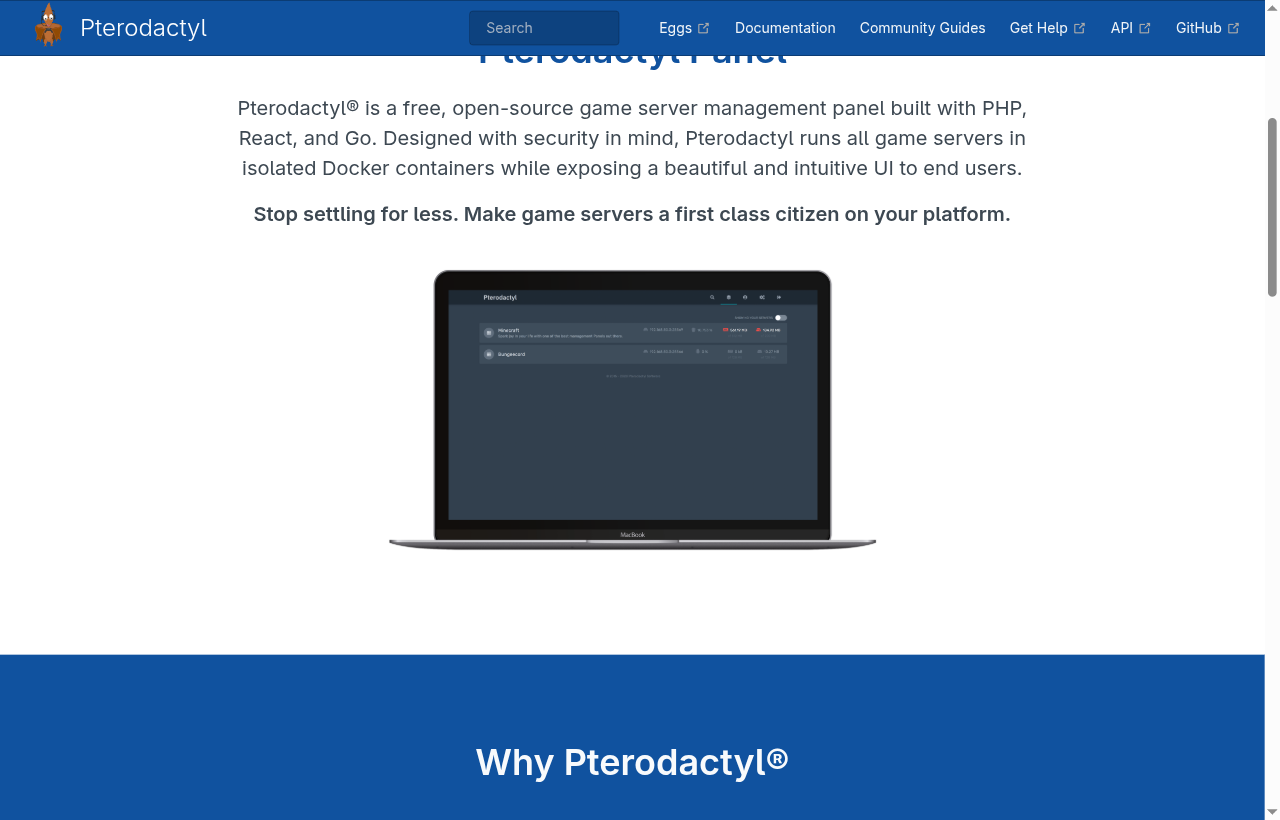
Pterodactyl's own project introduction describes it as a free, open-source game server management panel built with PHP, React, and Go, with game servers running in isolated Docker containers. Its panel installation docs say the panel runs on your own web server, expects root access, and requires administrators who are comfortable reading installation docs.
In practice, that usually means:
- a self-hosted web panel
- a database
- Redis
- a web server such as NGINX
- one or more Linux nodes running Docker-capable
Wings
That is a good fit when you want a real self-hosted control plane. If you already rely on that control plane, EnderDash can be added above it for the daily admin surface without replacing the panel underneath.
What EnderDash is built for
EnderDash is aimed at a different center point.
The focus is not "how do I provision or containerize game servers?" The focus is "how do I stay on top of the Minecraft servers I already have without bouncing across six tools every time something breaks?"
That pushes the product toward a different setup model:
- install a plugin agent on the target server or proxy, or run the standalone agent on a host
- keep the game server where it already lives
- connect through encrypted WebRTC, with relay fallback when a direct peer-to-peer path is not available
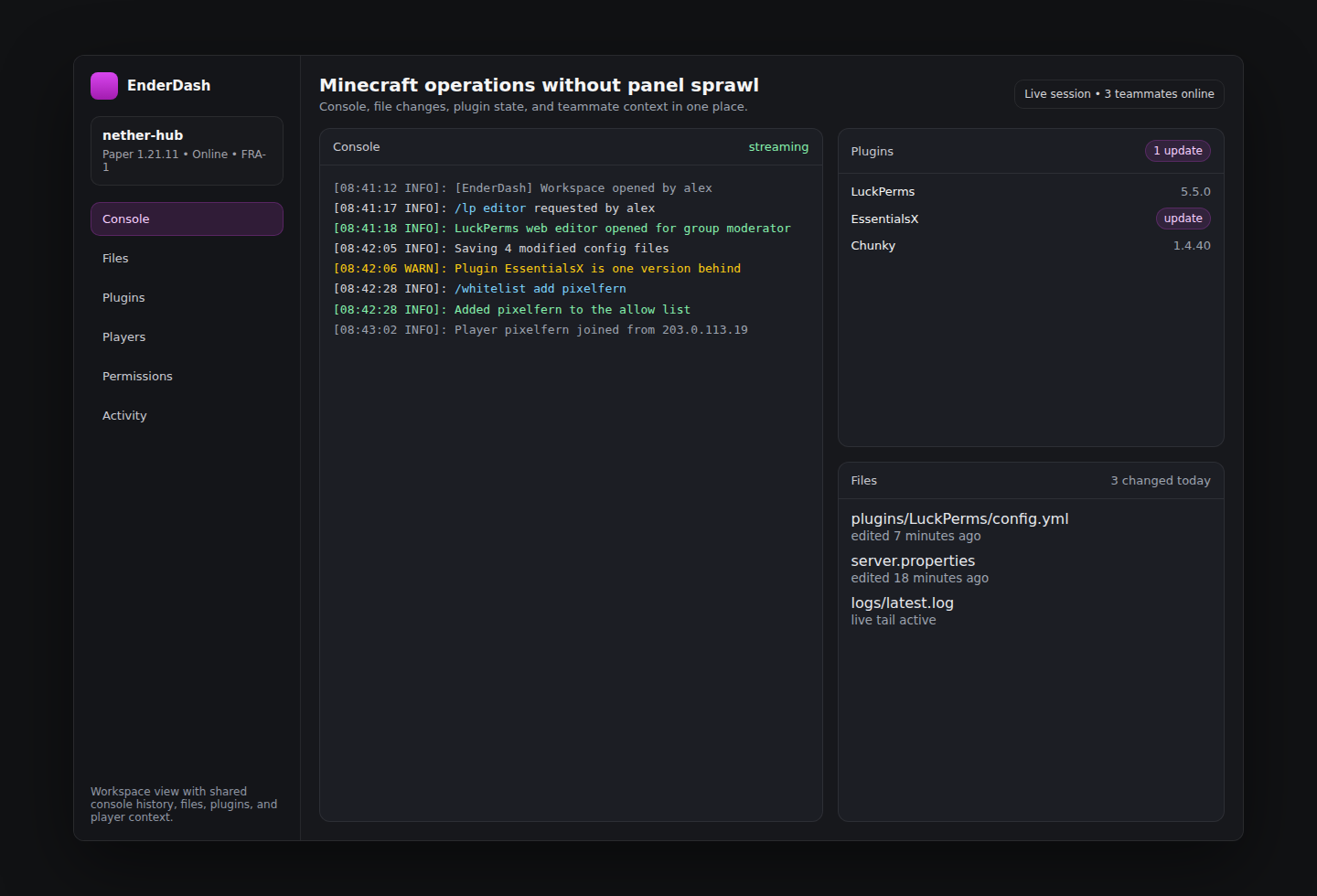
- use the hosted workspace for console, files, plugins, players, permissions, Ocelot, shell, and infrastructure tools
That operational surface can sit above a Pterodactyl-managed server just as well as a server you started some other way.
As of May 1, 2026, EnderDash is not self-hostable as a general product offering. If self-hosting the panel itself is a hard requirement, that point alone may decide the comparison for you.
The setup tradeoff is the biggest one
This is the part that matters most in practice.
With Pterodactyl, you are choosing to own the panel stack:
- panel installation
- web server
- PHP runtime
- database
- Redis
- Docker-capable Wings nodes
- upgrades and maintenance for that stack
You also own the panel's application key, queue worker, web server config, database, Redis, Wings configuration, Docker runtime, and node allocations. That is useful infrastructure when you need it, but it is still infrastructure.
With EnderDash, you are not choosing that.
You still own your actual server infrastructure, but you are not also creating a second self-hosted product around it just to get a modern admin surface.
That is not universally better. It is just a different tradeoff.
And if you already have Pterodactyl in place, you do not have to throw it out. You can keep Pterodactyl running the server and use EnderDash as the day-to-day operations layer on top.
Where each one shines
Pterodactyl is strongest when you care most about:
- self-hosting the panel
- node management
- containerized game server lifecycle
- broad multi-game support
- hoster-style infrastructure control
EnderDash is strongest when you care most about:
- Minecraft-specific daily operations
- shared console and live history
- file workflows
- plugin inventory and updates
- permissions work such as LuckPerms editing
- Ocelot AI for investigation, summaries, and proposed changes
- host shell access and infrastructure workflows
- Docker, Podman, and Kubernetes visibility where those targets are connected
- player, event, and statistics views
- reducing tool fragmentation for the team
EnderDash is also a good fit when Pterodactyl is already doing the server runtime work and you want a cleaner place to do the actual operational work.
Those are not the same center of gravity.
What the daily admin loop looks like
This is the part people usually skip in comparison posts.
The hard part of Minecraft administration is often not creating a server. It is the repetitive operational loop after the server is already online:
- read logs
- inspect players
- edit configs
- update plugins
- check permissions
- inspect host or container state
- ask Ocelot to summarize the evidence before a fix
- explain incidents to teammates
- answer "what changed?" without reconstructing everything from memory
Pterodactyl absolutely helps with server management. That is not in doubt. But the product's shape still starts from the panel and node layer.
EnderDash is trying to start one layer closer to the actual Minecraft admin workflow. In a Pterodactyl setup, that means EnderDash can sit on top of the server that Pterodactyl is already running and take over the daily admin work without taking over the lifecycle layer.
A practical comparison
| Area | Pterodactyl | EnderDash |
|---|---|---|
| Control plane | Self-hosted | Hosted by EnderDash |
| What you install | Panel stack plus Wings nodes | Plugin or standalone agent on each server, proxy, or host |
| Infrastructure model | Docker-centered game server management | Keep your existing infrastructure and add an operations layer with shell, Docker, Podman, and Kubernetes workflows where enabled |
| Connection model | Public panel and node services you operate | Encrypted WebRTC agent connection with relay fallback |
| Can they work together? | Yes, as the server layer | Yes, as the day-to-day admin layer on top |
| Multi-game support | Strong | Focused on Minecraft operations |
| Panel maintenance | Your responsibility | Not your responsibility |
| Minecraft-specific daily admin surface | Partial, depends on how you work | Core product focus |
| Self-hosting requirement | Satisfies it | Does not satisfy it today |
| Best fit | Hoster, infra-heavy, panel-first setups | Minecraft teams who want less fragmentation across panels, SSH, Portainer, Lens, plugin tools, and chat |
Security and exposure are different too
Pterodactyl's architecture assumes a real self-hosted panel and node environment. That is fine, but it is more infrastructure to secure.
EnderDash changes the shape of the problem. The control plane is hosted, and the server-side piece is an agent on the target runtime. The browser workspace connects over encrypted WebRTC, with relay fallback when needed. That means you are not creating a second public admin panel just to manage the server.
That does not make networking disappear. Your game server still needs to be reachable by players. It does mean the admin layer follows a different model from a classic self-hosted panel.
Which one should you choose
Pick Pterodactyl when:
- self-hosting is non-negotiable
- you want panel-plus-node control
- you are comfortable maintaining the stack around the panel
- your scope is broader than Minecraft operations alone
Pick EnderDash when:
- the Minecraft server already exists and you are tired of stitching together tools
- you do not want to maintain another panel stack
- your team cares about console, files, plugins, permissions, Ocelot, shell access, infrastructure state, and shared operational context
- you are tired of splitting daily work across Pterodactyl, SSH, Portainer, Lens, plugin web UIs, and chat
- you want the server to stay on your infrastructure while the admin surface gets easier
Questions people usually ask next
Yes. A practical setup is to let Pterodactyl keep running the server and use EnderDash on top of it for the daily operations layer. That only makes sense if each layer is doing a different job, though. If one tool is just compensating for the gaps of the other, the stack can get messy quickly.
Then Pterodactyl is the more obvious answer today. EnderDash does not meet a hard self-hosting requirement as a general product offering right now.
Then you may not need either product yet. The tradeoff changes when shared operational context, teammate access, and Minecraft-specific admin work start consuming time.
The real decision
This is not really "open source panel versus SaaS panel."
It is closer to:
- do you want to own the control plane itself?
- or do you want to own the game server infrastructure and stop there?
If you want the control plane on your hardware, Pterodactyl is a very reasonable answer.
If you want to keep your infrastructure but stop running extra panel infrastructure around it, that is the problem EnderDash is trying to solve. That can include a Pterodactyl-backed server where Pterodactyl stays in charge of the server runtime and EnderDash handles the operational layer above it.
Where EnderDash fits next
If EnderDash sounds closer to the way you already operate, the best next step is not a giant migration project. It is just connecting one server and seeing whether the day-to-day workflow feels cleaner.
Start with:
Connect Your First Server
Try the setup on one real server before turning this into a bigger platform decision.
Server Panels
See the product surface EnderDash exposes once a server is connected.
What EnderDash does differently from other Minecraft panels
Read the broader product-positioning argument beyond the Pterodactyl comparison alone.
Related articles
EnderDash is on Product Hunt
EnderDash is now listed on Product Hunt. Here is how we explain the agent-powered Minecraft operations workspace to a broader builder and server-admin community.
Can EnderDash upload custom JARs to Aternos?
EnderDash can make custom JAR uploads and Linux shell access easier on hosts that allow the agent, but it cannot bypass Aternos' free-hosting restrictions.
How to identify bot players and IP ban evasion on a Minecraft server
Learn which network, geography, session, and join-failure signals help reveal bot waves and players who may be bypassing IP bans, and how EnderDash makes that evidence easier to inspect.